| Husky of the Month |
Congrats Nikita, Archer, and Cheyanne,our November HOTM Winners!
Husky Cuddles!
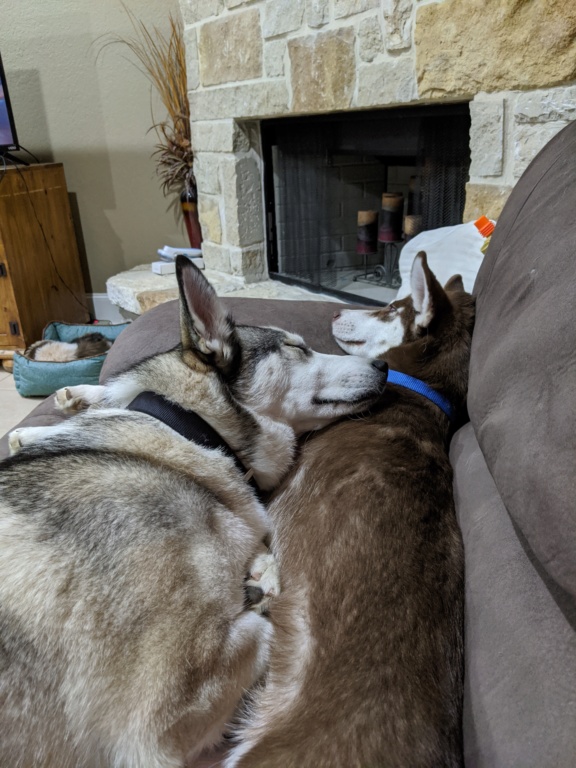  Thanks to all for this month's entries!
|
| Forum Rules | 1. Here we prefer clarity to agreement. Obviously not everyone is going to agree on a topic; here we prefer to talk out our differences in a respectful manner to ensure mutual understanding and respect.
2. Read the Stickies and Announcements. Each sub-forum may have specific rules which trump the Forum Rules in cases where there may be conflicting information. Read the rules of each board before you post so that you are clear on the expectations of the staff.
3. Respect ALL Staff and Admins. These people volunteer of their time and MUST be respected as well as their word adhered to. They are responsible for maintaining a free, open, clear and organized forum. Anyone found to be openly undermining any official ruling by a staff member will be warned.
4. Signatures: One picture only and no links. Images: To keep the forum looking neat and tidy, we ask that members insert just one picture only in their signatures. The picture should be no more than 200x500 pixels and should be of an appropriate subject, for example, your dogs and their names. Should you need assistance creating an appropriate signature, please PM an Admin and we would be happy to help! This is to ensure that signatures remain a welcome addition to our forum instead of a cumbersome distraction. Links: Hyperlinks in signatures--unless to a personal blog or photo stream of your dogs (like Flckr or Piscasa, for example)--are strictly prohibited. Please PM a staff member with any questions or concerns regarding this rule. |
| Rescue Spotlight |
Our current rescue spotlight is:
Delaware Valley Siberian Husky Rescue!

|
| Top Dog Website Award Winner! | |
| | |
| Author | Message |
|---|
Koda
Ms. Amicable

 Join date : 2009-05-20 Join date : 2009-05-20
Location : Glenville, NY
 |  Subject: Potty Training Wed Jun 30, 2010 8:39 am Subject: Potty Training Wed Jun 30, 2010 8:39 am | |
| Everyone goes through trying to house break their dog, whether it's a new puppy or a rescue, more than likely the dog will need a little training or reminder. When your dog is eliminating in the house, the best idea is to start over at the first step. Setting your dog up for success1. Don't give him the chance to fail. When your dog is eliminating in the house, most likely he tried to tell you in some way that he had to go, whether you understood it or not. Take your dog out at regular intervals. Puppies cannot be expected to hold it in for longer than an hour per month old they are! (For example, a 2 month old puppy can only hold it in for 2 hours.) This means that you may have to take your dog out as often as every hour for a puppy. For any dog, take him out as often as he needs so that he can be successful. 2. Know when he's got to go! Feed your dog at regular times. Whether you want to eventually free feed or not, regular/scheduled feedings should be used during house training. This means that your dog is going to need to go at about the same time everyday. Being able to predict when your dog has to eliminate is a great way to make sure you are there for her and setting her up to succeed. 3. Potty Training and Crates. The crate can be a useful tool when you are unable to watch your dog, for example, when you are out of the house or sleeping. However, you need to make sure the crate is setting him up for success too. The crate should only be big enough for your dog to walk in standing, turn around, and lie down. A normal dog will not defecate where he sleeps, thus he will be very reluctant to have an accident. However, if the crate is too big, it might give him enough room to go in one corner and lie down in another. You want to avoid this. For a puppy, they make crates with an adjustable wall panel to change the size of the crate according to your dog's needs as he grows. These are especially useful for help in potty training. Going outside4. Knowing your dog's signs. Know what your dog looks like, his habits, his facial expressions and actions when he has to go. Koda will come right up and stare me in the face and then start licking my arm if he has to go to the bathroom. Know your dog's signs so you can listen to him when he tells you. If you're having trouble understanding your dog, a good idea is to put a bell on the door you use to go out to the yard. Everytime you take your dog outside, take his paw and swat the bell so it chimes. If you are consistent, eventually your dog will learn that ringing the bell means "I'm going outside!" 5. Success gets PRAISE! THROW A PARTY when your dog is successful. You may feel stupid, but when your dog goes outside, praise, praise praise! Jump around with him, give him a little bit of play time, and lots of hugs and kisses. You want to reward that positive behavior. Accidents Happen6. Only correct the action, never the result. As tough as it sounds, you CANNOT punish the dog for a behavior that you did not catch with your own eyes. Dogs have no sense of cause/effect after the fact. If you don't see your dog messing in the house, he's never going to understand later what you're yelling at him for and you will just confuse him. (PLEASE DO NOT rub your dog's face in his mess... this will ONLY cause fear, aggression and mistrust. Your dog does NOT understand what that means.) 7. Correct and Redirect. If you DO catch your dog in the act, issue a firm and sharp "NO!" Then IMMEDIATELY take your dog outside. STAY outside until he goes again. When he does.... THROW A PARTY. Lots of praise, loves and hugs. You want to show him that in the house equals anger, but outside means party time  8. Make sure you clean up properly! If you do not use a cleaner that breaks down the urinary enzymes, your dog will smell where he went and think it is still okay to go there. That is why cleaning up properly is so important! Use an enzyme cleaner like Nature's Miracle. You can find it at any local pet store (even the large chains). You want to clean the spot THOROUGHLY so to avoid setting your dog up for failure in the future. Extreme Measures9. The tether system. Unfortunately, some dogs are just harder to train than others. In these cases where the above is not working, sometimes you might need to use the tether system. When your dog is in the house with you, attach him to your belt with a short leash. This way the dog is in your sight at all times. Keep your schedule and taking him out at regular intervals, but pay attention. The idea is that you're able to correct the bad behavior AS IT IS HAPPENING now instead of potentially missing it later. When you cannot keep the dog tethered to you, put him in his crate with a treat. Again, the idea behind potty training is to set your dog up for success! If you are consistent, your dog will eventually understand. Patience and persistence are the key! _________________ www.itsahuskything.com
It's a husky thing... you wouldn't understand. |
| | | | cmanding
Nutrition Subject Moderator

Join date : 2010-10-12
Location : Denver, CO
| | Subject: Re: Potty Training Wed Mar 02, 2011 1:44 pm | |
| I came across this interesting article and thought it might be helpful for people out there:
http://www.dogstardaily.com/training/errorless-housetraining _________________  |
| | | | Ashleymarie9807
Teenager

Join date : 2012-08-25
Location : NYC
| | Subject: Re: Potty Training Sat Aug 25, 2012 8:57 am | |
| Trying to get my dad's new four month old puppy Thunder trained, sadly I do not live there but am there 5 days a week, he does really good and then pee's in the house, I think I may have to undo the work I have already done, I have him trained to relieve himself at the park, my father wants him trained to do it in the yard. I know he is not fully developed(Can't hold himself longer than 3 hours) BUT on the other hand he has no accidents over night =-). |
| | | | Ashleymarie9807
Teenager
Join date : 2012-08-25
Location : NYC
| | Subject: Re: Potty Training Mon Aug 27, 2012 7:58 am | |
| I have heard Huskies are one of the hardest breeds to house break, and Thunder is living up to that reputation, he is technically my dads dog and I do not live at home, so for the next three days I will be over there on a strict "72 hour potty training mission". My goal is to have him 100% potty trained before my child starts school on Sep 6th. WISH ME LUCK! |
| | | | jschrader
Adult


 Join date : 2012-08-10 Join date : 2012-08-10
Location : Crown Point, IN
| | Subject: Re: Potty Training Mon Aug 27, 2012 1:42 pm | |
| - Ashleymarie9807 wrote:
- I have heard Huskies are one of the hardest breeds to house break, and Thunder is living up to that reputation, he is technically my dads dog and I do not live at home, so for the next three days I will be over there on a strict "72 hour potty training mission". My goal is to have him 100% potty trained before my child starts school on Sep 6th. WISH ME LUCK!
How’s that going?? It took me 4 months to potty train Nikko. I did not consider him fully potty trained until he stopped having any accidents. Although he very seldom has an accident anymore, it does happen from time to time. The new puppy is doing better than he did. It’s been 2 weeks and he actually goes to the door and scratches at it to go outside, but then sometimes he will just stop and pee! |
| | | | Ashleymarie9807
Teenager
Join date : 2012-08-25
Location : NYC
| | Subject: Re: Potty Training Wed Aug 29, 2012 9:42 am | |
| Well he knows to poop outside...Still having issues with the peeing accidents but they are not as frequent, instead of 10x a day its down to 3-4 lol. I don't understand it, he will pee outside, come in and pee again, I don't know where it all comes from lol. |
| | | | jschrader
Adult
Join date : 2012-08-10
Location : Crown Point, IN
| | Subject: Re: Potty Training Wed Aug 29, 2012 9:57 am | |
| I hear ya! It took Nikko forever to be housetrained. He would do the same thing…pee outside, then come in and pee again 5 minutes later. Or he would go outside, not go at all and then wait until he came back inside and pee. I would say he was about 5-6 months old before he was accident free.
Now, the little one, he is the poop machine! I counted yesterday that he pooped 8 times! I don’t think he even eats as much as he poops. This morning he went when we woke up, then he went again in the middle of our walks. What I hate is that he poops everytime we go for a walk, and he doesn’t give me any warning, it will just start coming out in the middle of the street! At least he could sniff in the grass but nope!
|
| | | | Ashleymarie9807
Teenager
Join date : 2012-08-25
Location : NYC
| | Subject: Re: Potty Training Wed Aug 29, 2012 10:14 am | |
| lmao sorry Jason you cracked me up, my boy only poops twice a day, after break fast and after his dinner BUT he pee's 24/7 non stop, except at night, he sleeps from 10pm-7:30 am accident free on the sofa. |
| | | | Koda
Ms. Amicable
Join date : 2009-05-20
Location : Glenville, NY
| | Subject: Re: Potty Training Wed Aug 29, 2012 10:16 am | |
| - jschrader wrote:
- Now, the little one, he is the poop machine! I counted yesterday that he pooped 8 times! I don’t think he even eats as much as he poops. This morning he went when we woke up, then he went again in the middle of our walks. What I hate is that he poops everytime we go for a walk, and he doesn’t give me any warning, it will just start coming out in the middle of the street! At least he could sniff in the grass but nope!
Yeah... that's not normal. Is he really pooping without warning? Does he ever poop in the house? Is it firm or mushy? That would have me a little concerned. What are you feeding him? _________________ www.itsahuskything.com
It's a husky thing... you wouldn't understand. |
| | | | jschrader
Adult
Join date : 2012-08-10
Location : Crown Point, IN
| | Subject: Re: Potty Training Wed Aug 29, 2012 10:21 am | |
| - Koda wrote:
- jschrader wrote:
- Now, the little one, he is the poop machine! I counted yesterday that he pooped 8 times! I don’t think he even eats as much as he poops. This morning he went when we woke up, then he went again in the middle of our walks. What I hate is that he poops everytime we go for a walk, and he doesn’t give me any warning, it will just start coming out in the middle of the street! At least he could sniff in the grass but nope!
Yeah... that's not normal. Is he really pooping without warning? Does he ever poop in the house? Is it firm or mushy? That would have me a little concerned. What are you feeding him? When we are walking (I walk both Nikko and him at the same time) I will feel him pull behind and look back and he will be squatting and pooping. He does not sniff or anything, just goes. Now this does not happen at home, sometimes he will poop in the house but it’s because we miss the signs. He won’t go without warning, he will sniff around first. It’s like the walks make him want to go. His poo is pretty mushy, but not runny (but not firm either). He was on Puppy Chow from the breeder but I switched him to Wellness Super5mix for puppies. That’s the same stuff I have Nikko on, and I transitioned his food slowly over 2 weeks. He goes to the Vet for his next round of shots on Saturday and I’ll be taking a sample with me. I’ll ask her about that. |
| | | | Koda
Ms. Amicable
Join date : 2009-05-20
Location : Glenville, NY
| | Subject: Re: Potty Training Wed Aug 29, 2012 10:24 am | |
| How long has he been on the new food? The food may not be agreeing with him. His poop shouldn't be mushy, it should be firm. Pooping that much would make me worry he's not getting any nutrients from it. Just because it works for one dog, doesn't mean it will work for the other, unfortunately. _________________ www.itsahuskything.com
It's a husky thing... you wouldn't understand. |
| | | | jschrader
Adult
Join date : 2012-08-10
Location : Crown Point, IN
| | Subject: Re: Potty Training Wed Aug 29, 2012 10:29 am | |
| - Koda wrote:
- How long has he been on the new food? The food may not be agreeing with him. His poop shouldn't be mushy, it should be firm. Pooping that much would make me worry he's not getting any nutrients from it. Just because it works for one dog, doesn't mean it will work for the other, unfortunately.
I got him on the 11th, and I started transitioning him a few days later on the 15th. I started 75old/25new from the 15th to the 17th, then 50/50 from the 18th to the 20th, and 25/75 from the 21st to the 24th, then starting on the 25th he was on all new. He gets 1 cup at 6am and 1 cup at 4pm. He was used to self feeding from the breeder so it’s usually a challenge to get him to eat all in one sitting, so he will usually eat about half his bowl in the morning, and the other half at noon. I also give him some canned pumpkin sometimes and for treats he gets chicken liver training treats and I also give them boiled chicken and carrots. |
| | | | Koda
Ms. Amicable
Join date : 2009-05-20
Location : Glenville, NY
| | Subject: Re: Potty Training Wed Aug 29, 2012 4:13 pm | |
| If it were me, I'd keep him on the food for about 2-3 weeks (so 2-3 weeks from the 25th). If he doesn't improve, put him on a diet of boiled chicken and rice (or eggs if he's grain-free) and let his stools firm up. Then try him on a different food with preferably a different protein source. Mushy stools approx 8 times a day is way too much. 3-4 times a day is normal. _________________ www.itsahuskything.com
It's a husky thing... you wouldn't understand. |
| | | | jschrader
Adult
Join date : 2012-08-10
Location : Crown Point, IN
| | Subject: Re: Potty Training Wed Aug 29, 2012 4:24 pm | |
| you mean just keep him on the Wellness I changed over to for the next 2-3 weeks? I already went through his puppy chow and I dont want to go back to that. I remember Nikko had runny poo's for a long time until he was almost 6 months old. I had figured it had to do with the amount of food I was giving him so when I cut it down it firmed up.
My vet was way off with feeding, suggested that I go by the bag's instructions. I use the canned pumpkin and yogurt which had worked better than the rice in the past |
| | | | Koda
Ms. Amicable
Join date : 2009-05-20
Location : Glenville, NY
| | Subject: Re: Potty Training Wed Aug 29, 2012 4:48 pm | |
| No, stick to the Wellness for 2-3 weeks. You could try cutting him back and see if that helps too. Bottom line is that amount of poop and the consistency of it is concerning. _________________ www.itsahuskything.com
It's a husky thing... you wouldn't understand. |
| | | | jschrader
Adult
Join date : 2012-08-10
Location : Crown Point, IN
| | Subject: Re: Potty Training Wed Aug 29, 2012 4:57 pm | |
| I'll try cutting him back a little. I only give him 2 cups as it is, and when it comes to treats he acts like hes starving, but when it comes time to eat it is usually hard to get him to finish it all, in fact I catch Nikko stealing his food! I know Nikko pooped alot when he was that age, but I don't remember it being 8 times a day.
Today has not been as much, he only went twice so far, both before 8am. He didn't go at lunch. |
| | | | Koda
Ms. Amicable
Join date : 2009-05-20
Location : Glenville, NY
| | Subject: Re: Potty Training Wed Aug 29, 2012 5:39 pm | |
| Ah, I missed that. Then don't cut back. He needs at least 2 cups a day.
It could be that something in the food is not agreeing with him.... hence his hesitation to eat it. But stick with it for a few weeks. If nothing changes, I'd start making some adjustments. _________________ www.itsahuskything.com
It's a husky thing... you wouldn't understand. |
| | | | jschrader
Adult
Join date : 2012-08-10
Location : Crown Point, IN
| | Subject: Re: Potty Training Wed Aug 29, 2012 5:51 pm | |
| Yeah, and especially since hes going to the vet for his shots and stuff I will at least know he is healthy and as long as he eats and everything is normal im sure he will be fine. Like I said, Nikko had runny poo for awhile but now its normal. |
| | | | Koda
Ms. Amicable
Join date : 2009-05-20
Location : Glenville, NY
| | Subject: Re: Potty Training Wed Aug 29, 2012 5:59 pm | |
| No, something definitely isn't right. Runny poo and going 8 times a day isn't normal. But at least let him truly get used to it first. Dogs take 2-3 weeks to truly adjust to a new food. _________________ www.itsahuskything.com
It's a husky thing... you wouldn't understand. |
| | | | Husky mum
Teenager

Join date : 2012-09-09
Location : Australia
| | Subject: Re: Potty Training Fri Sep 28, 2012 10:47 pm | |
| Thanks for the thread I feel our pup is a bit more nomal now.. I've been taking him out to the toilet and often doesn't go but will go when he gets inside and multiple times. We only brought him home last night so I know he's still adjusting, it doesn't help that the pups went toilet where ever they felt like with the owner - he is going to take a lot of work I think. So far I haven't noticed a tell for wee's, but will whine when he needs to go number two - unfortunatly I didn't catch on til it was too late as he whines at a few things... |
| | | | KotaBear
Teenager
Join date : 2012-09-09
Location : Southern Ohio
| | Subject: Re: Potty Training Sat Sep 29, 2012 4:50 am | |
| I recommend getting a training bell (as mentioned above). Kota did awesome with the bell!! At first he would ring the bell and immediately pee but at least she was making the connection that the bell meant she had to pee.
She was fairly easy to potty train but we were strict with her schedule and I got to the point where I knew when she needed to go before she even knew she had to go. Consistency is key, if ya ask me. |
| | | | Ashleymarie9807
Teenager
Join date : 2012-08-25
Location : NYC
| | Subject: Re: Potty Training Sat Sep 29, 2012 9:16 am | |
| Anyone Ever try the Pee Post? Just ordered two for Thunder, I must remember he is only 5 1/2 months old...The peeing is getting a bit old though, He knows outside=poop but for some reasson he can not resist peeing in the house  |
| | | | Molly-Darren
Newborn

Join date : 2012-10-25
Location : Dublin, Ireland
| | Subject: Re: Potty Training Tue Oct 30, 2012 4:21 pm | |
| Hi guys,
Having some strange difficulties with house training my puppy. She's peeing and pooping in the right place, but only wen myself and gf are there. If we're out or asleep then Molly goes wherever, mostly under my bed or twice ontop of spare bed! This is all poop as she tends to only pee on the training mats. Am i doing something wrong? It doesmt make sense. I praise her for correct eliminatioms and if i catch an incorrect one i quickly puck her up and put her on the correct place.
Where am i going wrong? Any help would be great guys.
Thanks Molly and Darren |
| | | | Robinhuskylover2231
Teenager
Join date : 2012-08-11
Location : Toronto, ON
| | Subject: Re: Potty Training Tue Oct 30, 2012 4:24 pm | |
| First of all I think you should get rid of the training pads- they teach them that it is okay to go in the house and in the end the training process is longer. Also, maybe until your put is fully house trained try crate training as they usually will not go where they sleep and shouldn't have enough room to do anything other then sleep and turn a circle. So my personal suggestion would be to take away the pee pads and start taking her out every 1-2 hours (even during the night-you could maybe do 3) and after she eats, sleeps, drinks, plays etc... It is alot of work but in the end your pup will be trained much faster. |
| | | | Molly-Darren
Newborn
Join date : 2012-10-25
Location : Dublin, Ireland
| | Subject: Re: Potty Training Tue Oct 30, 2012 4:35 pm | |
| I wish the pafs werent a neccesity as i know the drawback, but i dont have access to a confined outdoor space and so cannot bring her outside until her 12wk vaccinations, which she will recieve in 2wks so until then the training pads are a neccesity. I ordered our crate before Molly arrived but only recieved it today...zooplus are cheap for a reason!!
So the way to go is to keep her in crate when not eating, drinking or playing and control every elimination until it becomes second nature? Was hoping she could be trusted once she knows were to go, but suppose she must mature before any trust can be given...pity
thanks for the help
Darren |
| | | | Sponsored content
| | Subject: Re: Potty Training | |
| |
| | | | |
Similar topics | |
|
| | Permissions in this forum: | You cannot reply to topics in this forum
| |
| |
| | Latest topics | » Sasha’s scrapbook
by Artic_Wind Today at 1:56 am
» The Desert Pack
by amymeme Yesterday at 12:31 pm
» Does my husky looks purebred?
by TwisterII Mon Apr 08, 2024 10:06 am
» Rackety Placken Dog!!!
by Artic_Wind Sun Apr 07, 2024 3:09 am
» My dearest Mylo was strong until the very end. A memorial.
by jbealer Mon Mar 25, 2024 2:45 pm
» Advertisements
by Lostmaniac Mon Mar 25, 2024 2:20 pm
» What Sports Does Your Husky Do?
by TwisterII Mon Mar 18, 2024 10:49 am
» Hello again after 10 years
by TwisterII Mon Mar 18, 2024 10:43 am
» “G” scrapbook
by TwisterII Mon Mar 18, 2024 10:38 am
» Lycus' Scrapbook
by Artic_Wind Fri Mar 15, 2024 8:19 pm
» A day in the life
by amymeme Tue Mar 12, 2024 3:59 pm
» Mylo "My Love" Cervantes 10/09/2014-03/06/2024
by sibmom Sat Mar 09, 2024 7:14 pm
» Small intestine disease? Has anyone come across this?
by wooley4pk Wed Mar 06, 2024 4:08 pm
» A different kind of job for huskies
by TwisterII Wed Mar 06, 2024 10:37 am
» Back Legs failling and boot advice
by Me & Ghost Fri Mar 01, 2024 1:11 pm
» Hello from svmsmith08 and Laylah!
by TwisterII Mon Feb 26, 2024 11:08 am
» What's with all the "Grain Free" stuff?
by TwisterII Mon Feb 26, 2024 11:00 am
» Indoor digging ideas
by Ladywarbird90 Fri Feb 23, 2024 1:32 pm
» Made an IG to help husky rescues
by Lostmaniac Fri Feb 16, 2024 12:05 am
» Recall Information
by aljones Mon Jan 29, 2024 12:29 pm
|
|